
Documents from the archive
Numerous written sources, such as personal letters from the artist to acquaintances and friends, diary entries, and invoices from paint manufacturers provide valuable insights into the practical and creative decisions Baumeister had to make during the war.
From these documents, we can learn about the reasons for choosing certain materials, their origin, and the difficulties encountered in obtaining them.

Letter by Willi Baumeister, dated November 12, 1947, Archiv Baumeister at the Kunstmuseum Stuttgart.
Photo: Elia Schmid
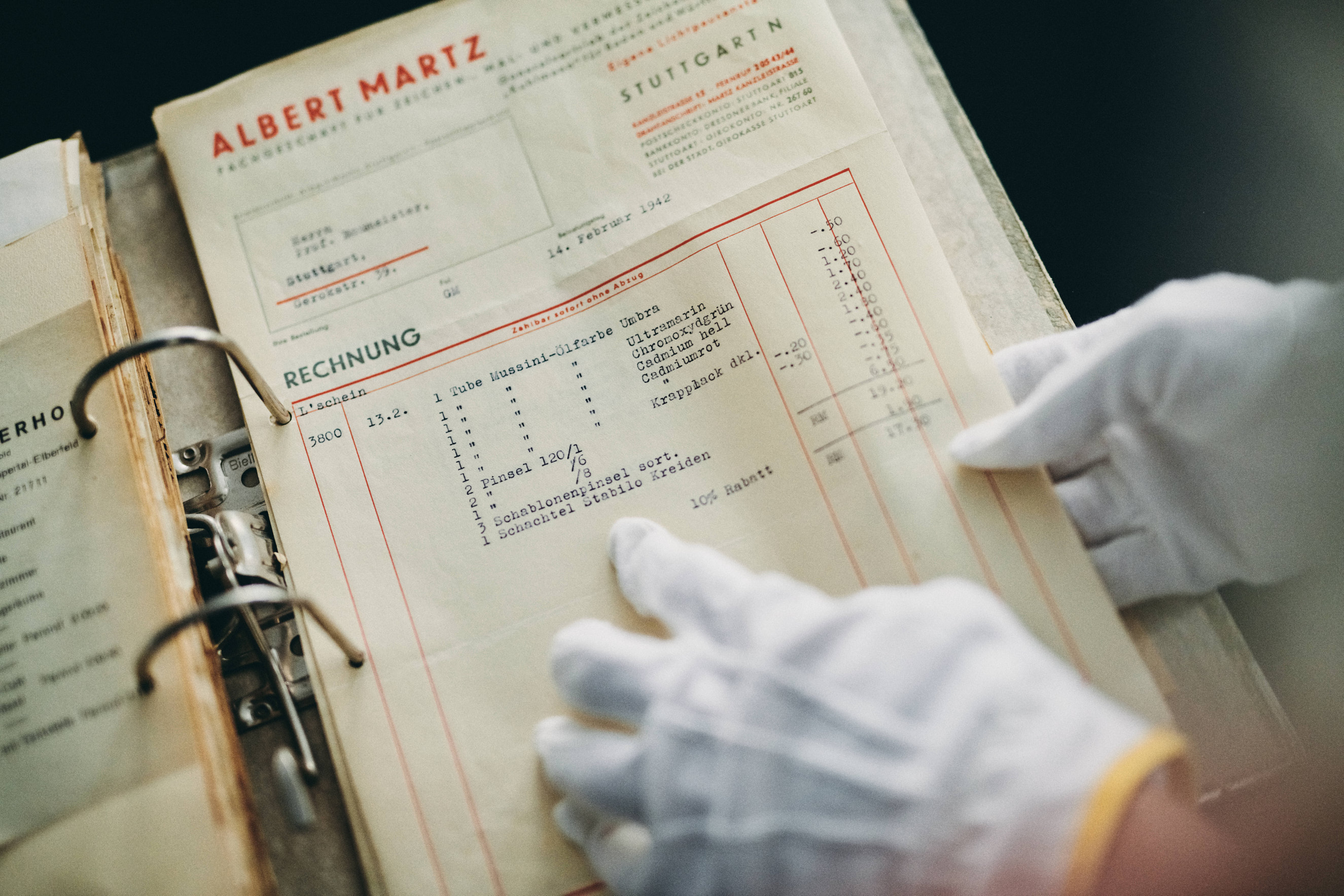
Letters document the daily challenges Baumeister faced, such as obtaining good-quality clothing and shoes. Historical invoices contain information indicating who supplied him with which materials.

In 1942, Baumeister ordered Mussini resin oil paints from Schmincke. Invoice from Albert Martz, dated February 14, 1942, Archiv Baumeister at the Kunstmuseum Stuttgart.
Photo: Elia Schmid
These included artists' paints, such as the Mussini resin oil paints from Schmincke listed on this invoice. On the basis of such invoices, we can research what these materials consisted of in Baumeister's time, and try to find in manufacturers’ archives historical reference materials that can be analyzed.

Invoice from Chr. Lechler and Son, dated June 6, 1955. Archiv Baumeister at the Kunstmuseum Stuttgart.
Photo: Elia Schmid
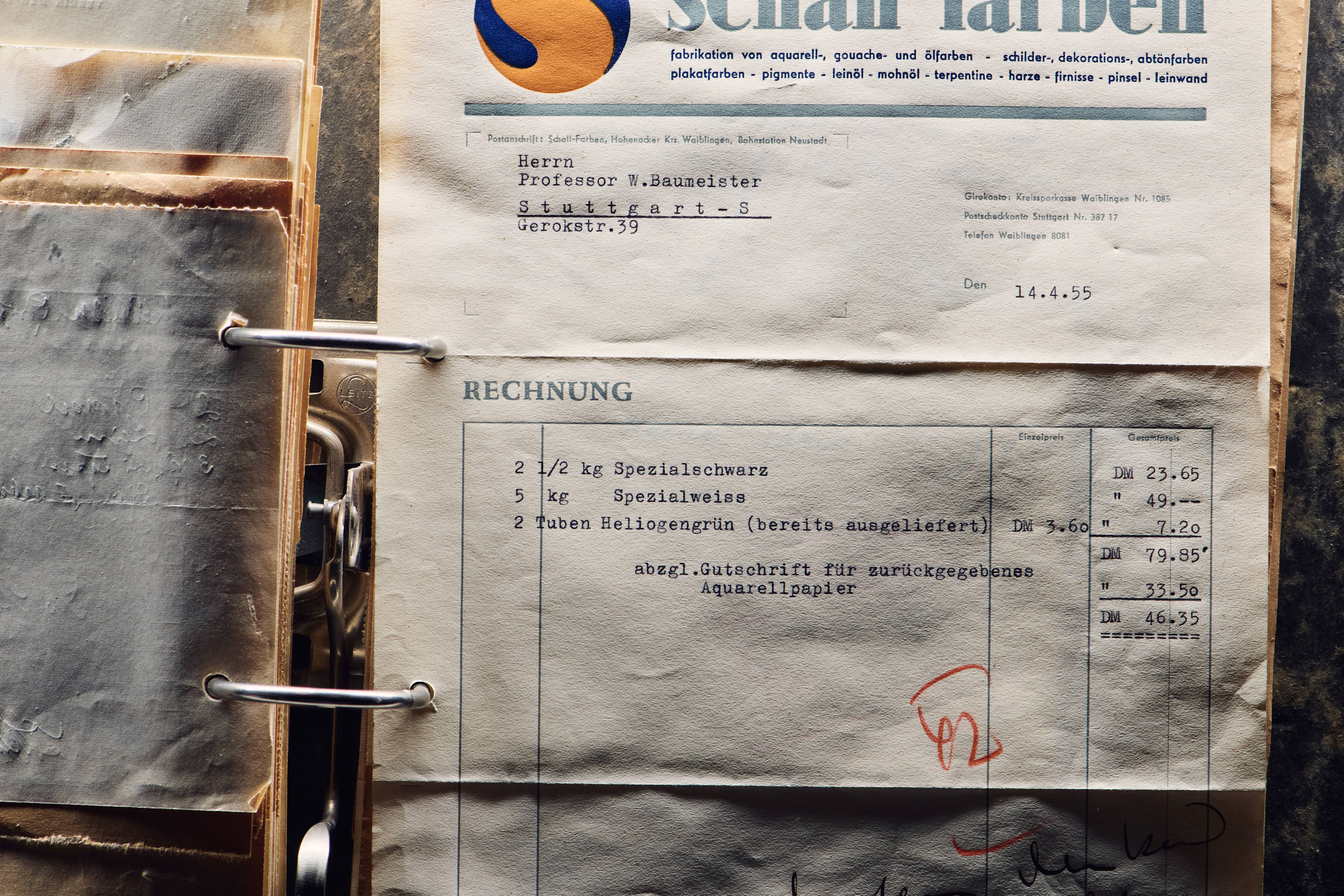
Baumeister also ordered large quantities of a white "putty" (“Spachtelmasse”) and a colorless "Durapon topcoat" (“Durapon-Überzugslack”) from the Lechler company – materials that were not originally intended for use on easel paintings, but rather for house painting. Thus, written sources such as invoices contain important information. Sometimes, however, new questions arise when they are examined: For example, it is unclear what "special white" (“Spezialweiß”) and "special black" (“Spezialschwarz”) consisted of, what was so special about them, and whether we can find these materials in his paintings.

Invoice from Schall-Farben, dated April 14, 1955. Archiv Baumeister at the Kunstmuseum Stuttgart.
Photo: Elia Schmid
Baumeister's estate contains many photographs that show him at work and provide important insights into his working process. There is also a film which enables you to literally look over the artist's shoulder as he works.

Die Fotografie zeigt Willi Baumeister in seinem Stuttgarter Atelier in der Gänsheidestr. 26 im Jahr 1954
CC BY-NC-SA 3.0 Archiv Baumeister im Kunstmuseum Stuttgart.
Historische Fotografie: Johannes Schubert,
Foto im Archiv: Elia Schmid
Baumeister's estate contains many photographs that show him at work and provide important insights into his working process. There is also a film which enables you to literally look over the artist's shoulder as he works.
The Archiv Baumeister at the Kunstmuseum Stuttgart holds many historical photos that provide important information about Baumeister’s working processes. The photograph shows Baumeister in his Stuttgart studio. In the foreground, you can see a bottle containing a white liquid – this is a clue to one of Baumeister's essential working methods: matting his paintings with a coating of buttermilk after painting them. Such coatings can still be found on many of his paintings today.
As researchers, we are very fortunate to have access to paintings that Baumeister himself created, but which he rejected, because he was not satisfied with them. Although he did not treat them as original works, he kept them and specially marked them in various ways.

Willi Baumeister, ca. 1951, 54 x 34 cm, Willi Baumeister Stiftung Stuttgart, Inv. No. V_002.
Photo: Elia Schmid
For example, he broke them apart in the middle – as with this painting on a hardboard panel.

Willi Baumeister, ca. 1931, 42 x 28.5 cm, Willi Baumeister Stiftung Stuttgart, Inv. No. V_005.
Photo: Elia Schmid
On others, he noted that they were not good enough: In such cases, he wrote "bad destroy" (“schlecht vernichten”) in pencil on the front, even though he had initially signed the painting.
These rejected works are very important for our project because they can often be dated relatively accurately, and their materiality is typical of certain phases of his work. When we examine them, we also learn something about the works that Baumeister labeled as originals.
Palettes provide an intimate insight into the painting process: They reveal exactly how Baumeister mixed his colors. Two palettes from his final creative years have been preserved in his estate and can be compared with the materials used in his paintings.

A palette from the artist's estate. Archiv Baumeister at the Kunstmuseum Stuttgart.
Photo: Elia Schmid
Baumeister often used old cardboard boxes as palettes on which to mix his colors.
Tools such as brushes and metal combs provide a direct insight into how he applied his paints and worked them into the surface.

Metal combs and various brushes. Archiv Baumeister at the Kunstmuseum Stuttgart.
Photo: Elia Schmid
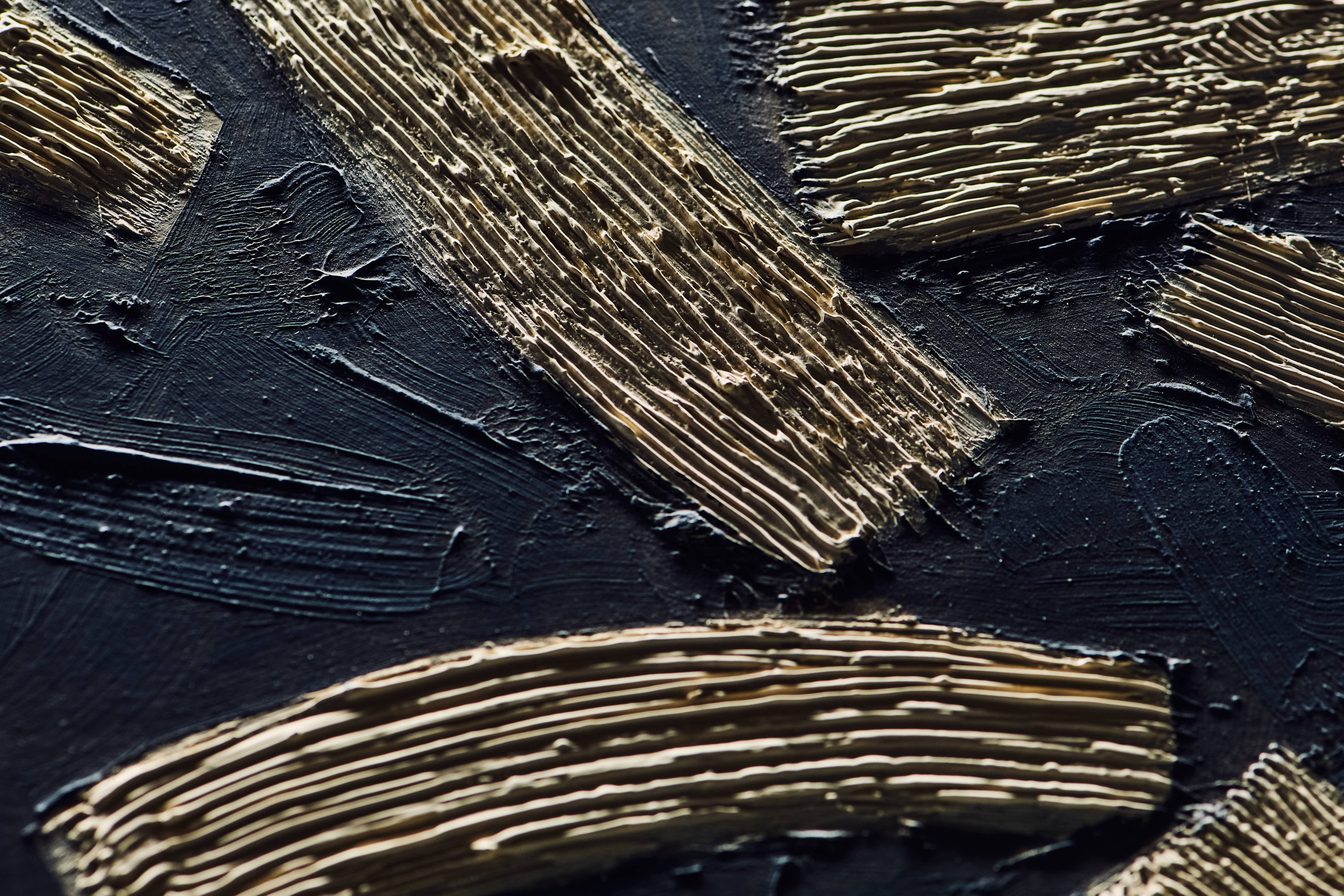
He was familiar with such metal combs, having used them as tools in his apprenticeship as a decorative painter. Traces of these combs, which he used to texture the surfaces of his freshly applied paints, can be found on many of his paintings.

Traces of the metal combs can be seen in the white paint. Detail from: Willi Baumeister, discarded painting, ca. 1954, Willi Baumeister Stiftung Stuttgart, Inv. No. V_012.
Photo: Elia Schmid
The artist's estate, the historical material collection of the ABK Stuttgart, and the archives of the artists’ paint manufacturers Schmincke (from Erkrath near Düsseldorf, Germany) and LUKAS (formerly called Fr. Schoenfeld) at the Conservation Center (RED) in Düsseldorf, contain historical tube paints, varnish bottles, and similar items that can provide crucial clues to the original composition of the painting materials used in the paintings. They are therefore important reference materials for our investigations of paintings.

Historical tube oil paints in the RED / LUKAS archive can be used as reference materials. © LUKAS.
Photo: Elia Schmid
The ABK Stuttgart's collection of materials contains a number of historical material samples from the period when Baumeister was a professor at the academy. Old samples such as these are valuable reference materials for the material analyses of the paintings. They are helpful for working out the original composition of the paints.

Reference material samples from the historical collection of the Archaeometric Laboratory at the ABK Stuttgart.
Photo: Elia Schmid