
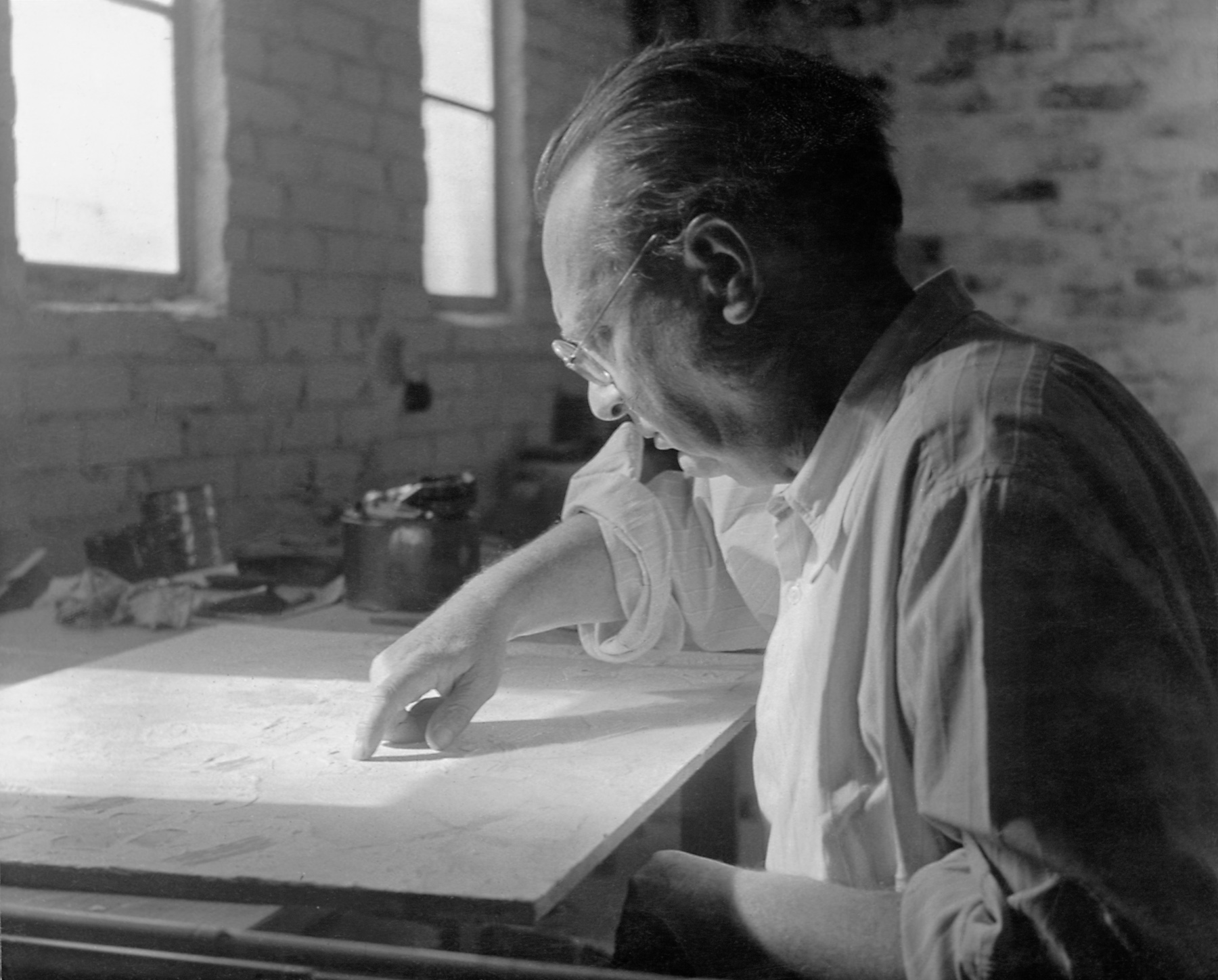
The painter Willi Baumeister (1889–1955) is one of the most important German artists of the postwar period and one of the most significant representatives of non-representational painting. He taught painting as a professor at the Stuttgart Art Academy from 1946 onwards. Baumeister was barred from public teaching during the Nazi era, when his art was classified as "degenerate," and many of his works were confiscated. He was forced to continue painting privately and had only limited access to painting materials.
The period from the Nazis' rise to power (1933) through World War II to the postwar period (1945–1955) was therefore formative for him—personally, artistically, and also in terms of his painting technique.

Willi Baumeister in his studio at Gänsheidestr. 26, Stuttgart, 1948.
CC BY-NC-SA 3.0 Archiv Baumeister at the Kunstmuseum Stuttgart.
Photo: Kyra Stromberg (?)
Painting materials were in short supply, like many other raw materials, particularly during World War II, but also in the years before. Thus, artists aimed to replace them with new materials possessing similar properties – so-called “substitutes” (“Ersatzstoffe”). However, these materials did not generally have a good reputation because they were often seen as inferior replacements for the original materials.
Such substitutes included hardboard instead of wood, or newly developed plastics (synthetic materials) instead of natural materials, such as linseed oil or natural resins.
An important place where Baumeister was able to experiment with new materials was the "painting laboratory" (“Maltechnikum”) of the Wuppertal-based industrial paint and varnish manufacturer Dr. Kurt Herberts. He hired Baumeister in 1937 to conduct painting experiments, and he provided him with his products for this purpose. A postcard from this period documents that although Baumeister could not exhibit his work in public, he was obviously busy experimenting with these materials as Herberts’s employee.

Postcard with drawing by Hans Hildebrandt, addressed to Margarete Baumeister-Oehm, dated November 15, 1940
(Text of postcard: “Poor Willi is terribly stressed. In Wuppertal: He eats, stipples, paints, varnishes, types, and thinks! ”)
(Willi Baumeister Stiftung Stuttgart, CC BY-NC-SA 3.0, Inv. No. MBO 1503).
Available online: https://www.margarete-oehm.org/sites/default/files/autograph_download/MBO_1503_2.pdf
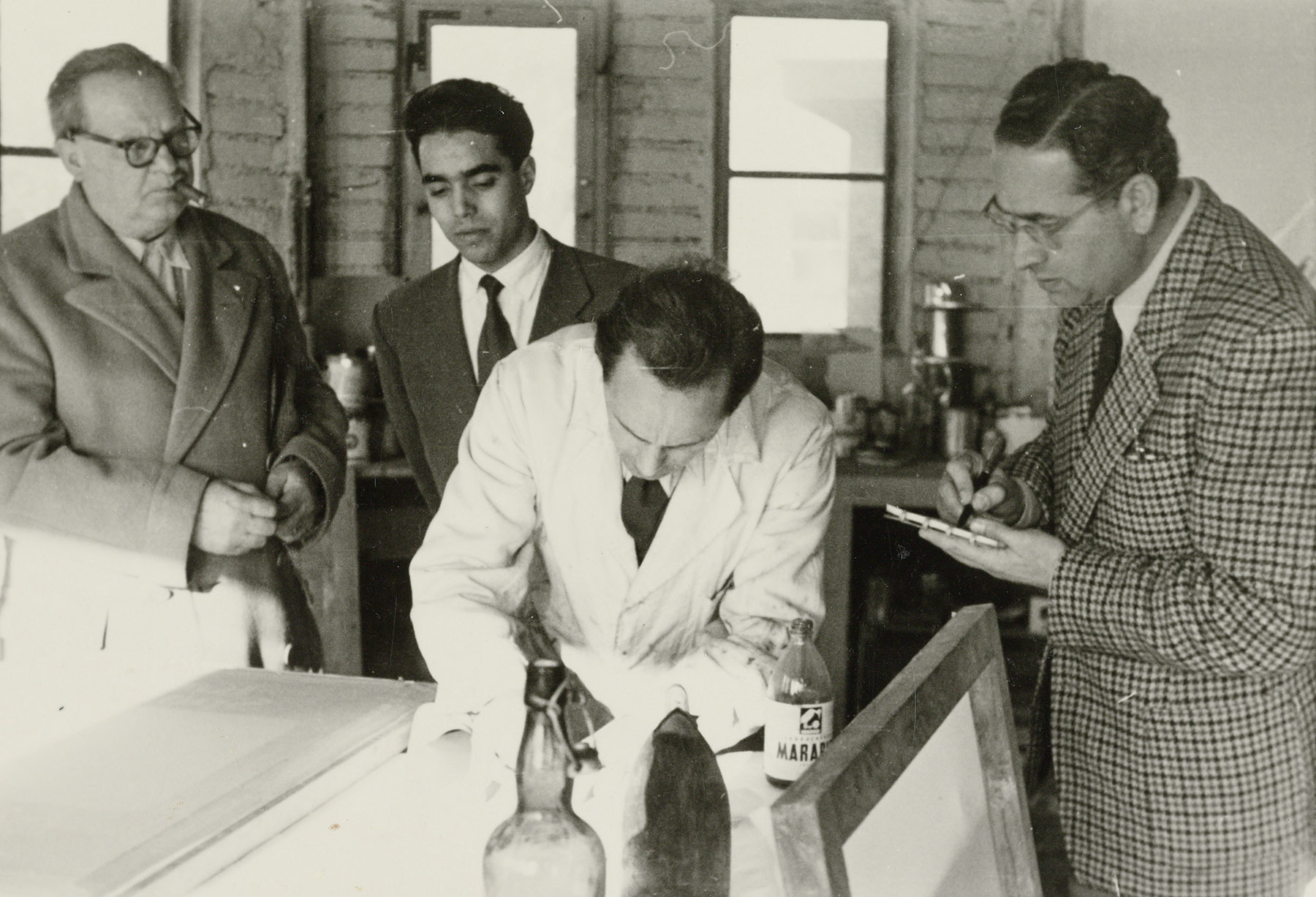
What is interesting is that he did not experiment with artists’ paints, but rather with Herberts’s industrial lacquers – with unfamiliar properties that Baumeister first had to test for his own painting purposes.
He continued such experiments even after the war: A photo from the post-war period shows him together with three other people conducting painting experiments – a bottle from the Stuttgart-based paint manufacturer Marabu can be seen on the table.

Willi Baumeister (left) with three unknown persons, Domberger printing workshop, Stuttgart, circa 1951.
CC BY-NC-SA 3.0 Archiv Baumeister at the Kunstmuseum Stuttgart.
Photo: unknown photographer
The painter Willi Baumeister (1889–1955) is one of the most important German artists of the postwar period and one of the most significant representatives of non-representational painting. He taught painting as a professor at the Stuttgart Art Academy from 1946 onwards. Baumeister was barred from public teaching during the Nazi era, when his art was classified as "degenerate," and many of his works were confiscated. He was forced to continue painting privately and had only limited access to painting materials.
The period from the Nazis' rise to power (1933) through World War II to the postwar period (1945–1955) was therefore formative for him—personally, artistically, and also in terms of his painting technique.
Painting materials were in short supply, like many other raw materials, particularly during World War II, but also in the years before. Thus, artists aimed to replace them with new materials possessing similar properties – so-called “substitutes” (“Ersatzstoffe”). However, these materials did not generally have a good reputation because they were often seen as inferior replacements for the original materials.
Such substitutes included hardboard instead of wood, or newly developed plastics (synthetic materials) instead of natural materials, such as linseed oil or natural resins.
An important place where Baumeister was able to experiment with new materials was the "painting laboratory" (“Maltechnikum”) of the Wuppertal-based industrial paint and varnish manufacturer Dr. Kurt Herberts. He hired Baumeister in 1937 to conduct painting experiments, and he provided him with his products for this purpose. A postcard from this period documents that although Baumeister could not exhibit his work in public, he was obviously busy experimenting with these materials as Herberts’s employee.